
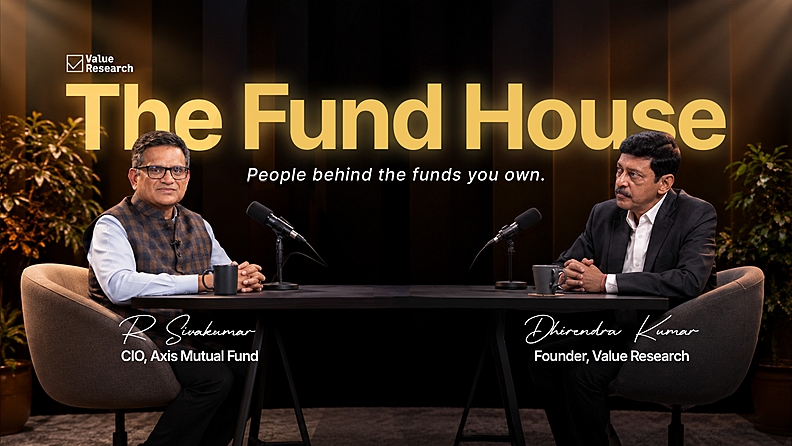
24-Nov-2026 | Dhirendra Kumar

Axis's new CIO wants bigger bets and second place
R Sivakumar has cut the stock count in Axis's equity funds by a fifth and wants managers to back their calls harder. Yet his target is second place. The reason lies in bond arithmetic.
When a fund house comes out of a bad patch, it usually plays safe. Axis Mutual Fund is doing the opposite. R Sivakumar, its chief investment officer since March, wants his fund managers to take more risk. "If you hug the index, you will get index returns. And where is the joy in that?"
He has started with the portfolios. Axis funds hold about 20 per cent fewer stocks than a year ago, he says. The names are mostly the same. The funds own more of each.
Axis knows what it costs when a style stops working. I remember the two-page note on quality and growth it put out early on. For a decade the idea worked, and from 2018 to 2020 almost every Axis equity fund finished in the top half of its category. Then it broke. In 2021 and 2022, Axis equity funds finished in the bottom quartile 16 times out of 21.
Sivakumar's explanation is more useful than the usual line about growth falling out of favour. From 2022, he says, stocks in the value index grew earnings as fast as those in the growth index—about 20 per cent a year—while trading at 18 times earnings against 30. Axis owned the expensive growth. It missed the cheap growth because it was not looking. Its analysts covered about 200 companies. The fix was more analysts, up from about five to 14 by his count, and coverage of 450-plus companies. The philosophy stayed: growth first, price second.
The bigger bets come with rules a bond manager would recognise. Sivakumar ran Axis's fixed income from 2010 to 2024, and he explains risk with bond arithmetic. A fund with ten bonds at 10 per cent each can earn extra yield for three years and lose all of it—and more—to one default. Spread across 30 issuers at 3 per cent each, the same default still leaves the fund ahead. His 3 per cent cap on a single-A bond is "cast in stone". In equities, no fund manager can buy a stock the analysts do not cover. "Full stop."
His target surprised me more. Axis does not aim to top the charts. It aims for the second quartile, every year. A fund that stays there, he argues, ends up in the top quartile over five years and near the top over ten, because the funds chasing first place swing between the top and bottom quartiles. It is sound arithmetic, and any investor who switches to last year's winner should hear it.
It also sets the test for Axis. On 20 November, more than nine-tenths of Axis's active equity money sat in the top half of its categories on one-year and three-year returns, in Value Research data. On five-year returns, about four-fifths sat in the bottom half. Sharper portfolios raise the odds of the very swings he wants to avoid. His answer is that firm limits make bigger bets safe. The next two years will show whether he is right.
The video has more that fund investors can use. He explains why Axis sold power utilities while calling power a long-term story: the data centres are "not here yet", and the prices already assume them. He describes the consumer businesses he likes, which are not the traditional FMCG companies most people picture. He also has a pointed message for anyone who has put nearly all their money into mid-cap, small-cap, and flexi-cap funds over the past three years, and he backs it with the yields bonds pay today. That part is worth hearing in his own words.


 New Process Alert
 Seems like you've uploaded a wrong QR code. Please upload the QR code downloaded from MF Central platform.


