 Widely read:


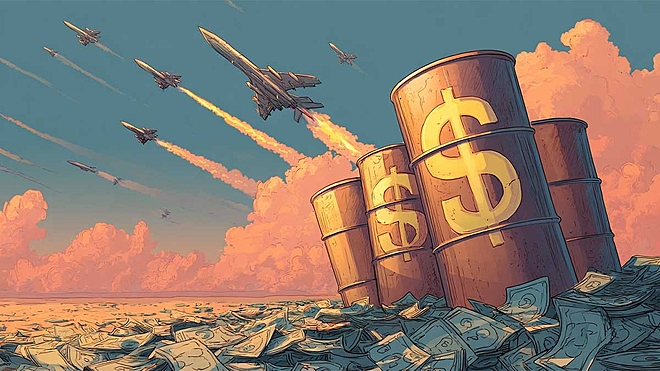
Summary: Every crisis produces the same call: a panicked investor who has done everything right, asking what to do. The answer is never what they're hoping to hear, and it doesn't get easier the more you know.
Before the markets open, before the anchors speak, before the WhatsApp groups wake up, there is GIFT Nifty telling you what kind of day is coming. After all, it's the world's verdict on India, delivered before the opening bell.
That morning, the verdict was grim: down sharply, flashing red, pricing in another night of bad news from the Gulf. Vikram had seen it too. He called at 9:10 in the morning.
"Have you seen the news?" He didn't wait for an answer. "Oil is surging. The Strait of Hormuz is basically shut. There are missiles over the Gulf. I need to know what to do with my money."
This isn’t the first time we're seeing this panic. I've taken calls like this during Covid, during the 2022 rate shock, during demonetisation. They always start the same way—with a headline, and underneath it, a question that isn't really about the news at all.
Vikram is 38. An engineer in Pune, six years of SIPs, a decent allocation across equity and debt. On paper, he has done everything right.
"I think I should reduce equity," he said. "War, oil, inflation. This can't be good for markets."
"Why do you think that would help?" I asked.
"Because I'd be doing something. Protecting myself."
There it was.
You are not reacting faster than the market. You are reacting after it.
This is the thing nobody tells you about investing in a real crisis: the danger isn't ignorance. Vikram knew, abstractly, that selling during a downturn locks in losses. He knew recoveries can happen fast, and that missing the 10 best days in a market cycle can be detrimental to your long-term returns.
He knew all of it. And he still wanted to sell.
Because knowledge and instinct are different systems. And in a crisis, instinct is louder.
Every headline, every panicked voice note in every WhatsApp group, every colleague who'd already moved to fixed deposits, all of it fed a feeling that staying put was the same as doing nothing. That doing nothing was irresponsible.
"Here's what I want you to understand," I told him. "By the time you feel the urge to act, the market has already acted. Everything you're reading this morning—the oil disruption, the Hormuz closure, the FII outflows—markets priced all of it before your alarm went off. You are not reacting faster than the market. You are reacting after it."
Silence.
"So there's nothing I can do?" he said.
"There's plenty you can do. The question is whether any of it will help."
What's changed in your life, not the news
We went through his portfolio. His equity allocation was where we'd agreed it should be. His debt buffer was intact. His SIP was due in four days.
"What's changed?" I asked. "Not in the news. In your life. Your timeline, your goals. Has any of that changed?"
He thought about it. "No. But the world has changed."
"The world changes constantly," I said. "That's what markets are. Not a smooth escalator upward. A series of shocks and recoveries. You signed up for this when you started the SIP. You just didn't feel it until now."
Geopolitical crises feel different from other market risks because they are visceral. There are explosions on your phone screen, casualty counts, maps with arrows. Your brain is not designed to distinguish between ‘this is dangerous to me personally’ and ‘this is dangerous to the market.’ Both register as threat. Both demand response.
But they are not the same thing.
During the Russia-Ukraine war, global markets corrected sharply. Indian markets, however, went on to deliver strong returns. In fact, the very rally that drew Vikram into equities came after that phase. The investors who benefited were not the ones who timed exits and re-entries perfectly. They were simply the ones who stayed invested.
The only question that matters
"But what if this one is worse?" Vikram asked.
It's a fair question. The Executive Director of the International Energy Agency called the current situation worse than the energy crises of the 1970s and the Russia-Ukraine war combined. I didn't want to be glib about it.
"It might be worse," I said. "I won't tell you I know how this ends. Nobody does. The question isn't whether the next few months will be painful. They probably will be. The question is whether your portfolio was built to survive pain, or only to perform in calm."
If your allocation is right and your timeline is long, the portfolio is already doing its job. Its job is not to avoid volatility. It is to survive it and be present for the recovery. And if this crisis has shown you that you're carrying more equity than you can honestly hold through a downturn—rebalance thoughtfully when things stabilise. But don't sell in panic. That just converts a temporary loss into a permanent one.
Vikram kept his SIP running. He called twice more that week, both times after markets closed, both times to talk more than to decide.
The last time, he said: "I keep waiting for the moment when it feels okay to stay invested. But I don't think that moment is coming."
"It isn't," I said. "You don't stay invested because it feels safe. You stay invested because your plan says to."
A pause.
"That's harder than it sounds," he said.
"It always is."
That, in the end, is the whole story.
Want to know if your portfolio is built to survive moments like this?
Value Research Fund Advisor helps you see whether your funds are doing the job you hired them for, and whether your allocation can hold through real-world volatility, not just calm markets.
Invest with a plan you can stick to, even when it doesn’t feel easy.
This article was originally published on March 26, 2026.
Disclaimer: This content is for information only and should not be considered investment advice or a recommendation.
For grievances: [email protected]
Ask Value Research 
 New episodes every Friday










 New Process Alert
 Seems like you've uploaded a wrong QR code. Please upload the QR code downloaded from MF Central platform.


