 Widely read:




Manju Das was a housekeeper from a village in India. She cooked, cleaned, and washed for Anil Kumar—a senior partner at McKinsey—in his California home.
What Manju didn’t know: Kumar was feeding insider information to hedge fund king Raj Rajaratnam. One of Wall Street’s biggest trading scandals. And he had stolen her identity.
He set her up as an “India-based offshore investor.” Routed millions through accounts in her name. From 2003 to 2009, hundreds of thousands of dollars flowed through accounts bearing Manju Das’s name every year.
She was, on paper, the richest housemaid in the world. She never saw a rupee of it.
When the FBI cracked the case, Manju was a witness. Not a beneficiary. Kumar served for two years. The money was seized. Her name had been worth millions on Wall Street while she scrubbed floors for a fraction of minimum wage.

Manju’s story is extreme. The principle is not.
In millions of Indian households, women’s names appear on documents. Joint holders. Nominees. Co-applicants. Without those women understanding the decisions behind those documents. Their names are on the paperwork. Their minds are not in the room.
This article is about why that has to change. Not as a feminist argument. As a survival argument.
Three scenarios nobody plans for
Scenario one: your spouse dies suddenly. In one day, you need to know everything. Which bank? Is there insurance? Who’s the nominee on the mutual funds? Is the flat in your name? Does a home loan exist? Does it have credit life insurance? These questions arrive on the worst day of your life. They don’t wait for you to grieve.
Scenario two: divorce. The Supreme Court says stridhan is yours alone. Section 14 says your property is absolute. The 2005 Amendment gives daughters equal coparcenary rights. The law is clear. But if you don’t know what you own—what’s in your name, what your rights are — the law can’t help.
When Pooja Sharma walked away from her Delhi marriage, her husband kept her gold. Gold that was legally hers. She lost it because nobody told her the law existed.
Scenario three: medical emergency. Your spouse is in the ICU. You need to access savings, file health insurance claims, and understand policy exclusions. If you’ve never seen the document or never checked which hospital has a tie-up, you discover all this in a hospital corridor at 2 AM.
The nominee trap
Let me explain something that catches almost every Indian family off guard.
A nominee is not the same as a legal heir. Most people assume: name wife as nominee, she gets the money. This is wrong.
A nominee is a custodian. Authorised to receive money on behalf of legal heirs. If no will exists, money is distributed per succession law. Which may include parents, siblings, and children, as well as the spouse.
If your husband’s parents are alive, they have a legal claim. Even if you are the nominee.
This single misunderstanding has devastated more Indian widows than almost any other gap in financial knowledge. Joint accounts and joint nominations are administrative conveniences. Not financial security. Real security comes from knowing the full picture. And having a will that makes it clear.
How to have this conversation
In That Long Silence, Shashi Deshpande’s Jaya discovers she knows nothing about the family’s finances. Educated. Urban. A writer. And financially blind. Her “long silence” isn’t about marriage. It’s about money. About all the questions she never asked because the architecture didn’t make room for them.
The family financial review doesn’t need to be a confrontation.
Start here: “Let’s make sure we both know where everything is. In case something happens to either of us.” Frame it as a shared responsibility. Not suspicion. As preparedness. Not distrust. Pick a weekend. Bring chai. Fill this in together:
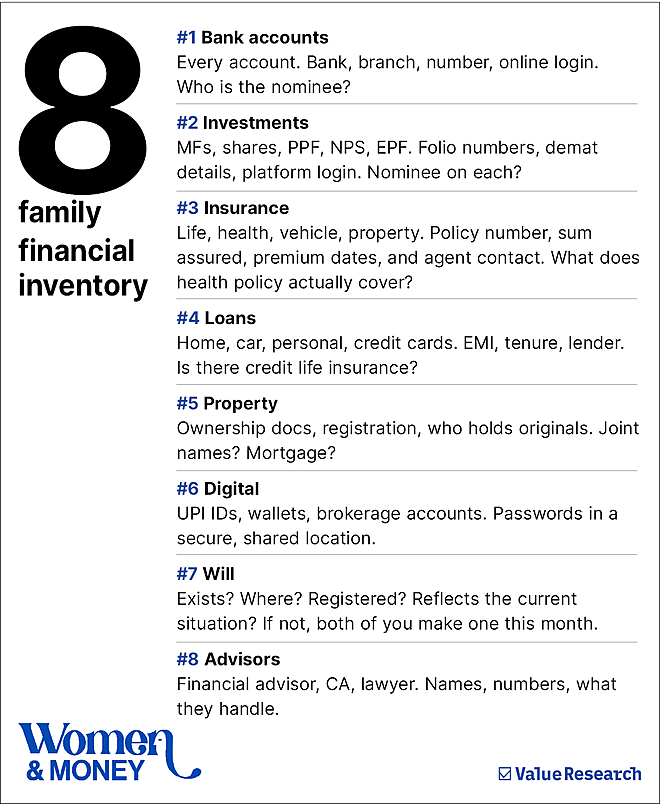
The Nair Ammachi controlled the household treasury for centuries. The Chettinad Aachi managed inter-generational wealth while husbands traded across oceans. These were not extraordinary women. They were ordinary women with ordinary access. That’s all it took.
You don’t need permission to know your family’s financial picture. You need to give yourself that permission.
Manju Das’s name was on accounts worth millions. She never knew. Don’t let your name be on documents you’ve never read.
Ask. Know. Insist.
Her Money, Her Future • A 5-part Women’s Day special by Value Research
Next: Investing with confidence in a ‘male domain’
Ruchira Sharma, Senior Editor, Narrative & Long-form | Value Research
She writes about money the way it actually lives in Indian families, tangled with culture, silence, gold, and love. At Value Research, she anchors Investors' Hangout and Fund Manager Interviews, narrates Dhirendra Kumar's First Page, and leads the audio-visual team. Her Money, Her Future brings together her two crafts: the journalist's instinct for the untold story and the financial editor's demand for evidence in every sentence. Previously, 14 years at India Today: scripting, production, and long-form storytelling.
This article was originally published on March 08, 2026.
Disclaimer: This content is for information only and should not be considered investment advice or a recommendation.
For grievances: [email protected]
Ask Value Research 
 New episodes every Friday










 New Process Alert
 Seems like you've uploaded a wrong QR code. Please upload the QR code downloaded from MF Central platform.


