 Widely read:


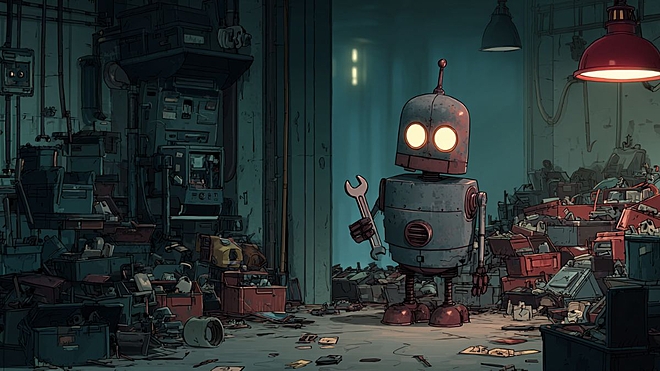 Aditya Roy/AI-Generated Image


I'll believe AI is replacing customer service jobs when I have one satisfactory interaction with an AI support agent. Just ONE. I'm not asking for exceptional service or a warm human connection. All I want is non-anger-inducing. After years of being trapped in circular conversations with chatbots that sound helpful but fundamentally do not understand my problem, I remain deeply sceptical about the breathless predictions of an imminent AI takeover.
This isn't just about my personal frustration with the AI customer service theatre. It reveals something fundamental about the current AI panic sweeping through tech investing. Everyone is convinced that AI agents will replace everything, that SaaS companies are doomed and that traditional software businesses will be wiped out by probabilistically generated code maintained by skeleton teams. The gap between what AI demos well in controlled environments and what it actually delivers when confronting the messy real world remains enormous.
Suggested read: The thinking investor’s advantage
David Sacks, currently serving as the White House AI advisor, recently said this. Take Salesforce, he argued. "You are not going to replace that with code that has been spit out of a coding assistant that has not been fully vetted," he pointed out. "Think about how many bug reports on Salesforce's code base over the last 25 years. Maybe millions of them. That system has been tested across thousands of large customers and enterprises." The point is obvious. Those decades of bugs aren't just repairs – they represent 25 years of institutional memory, edge cases discovered through actual usage, compliance requirements that emerged gradually and integration challenges that nobody anticipated until they caused a crisis. That knowledge cannot be replicated overnight by an AI engine, no matter how impressive its demos. I can personally vouch for what Sacks is saying because I have babysat the same thing with Value Research’s internal systems and websites for a quarter of a century now.
The idea that a business would remove these battle-tested systems and replace them with code generated probabilistically yesterday strains credibility. It's rather like suggesting investors should dump their diversified portfolios built over decades for whatever fund topped last quarter's performance charts. The parallel isn't accidental – in both cases, what looks boring and slow is often what's actually valuable.
Suggested read: The threat of innovation
This is where the AI panic fundamentally misunderstands enterprise software. These systems aren't valuable because they're elegant or use the latest technology. They're valuable precisely because they're boring and proven.
Think about what actually keeps businesses running. It's not the exciting features demoed at conferences – it's the unexciting plumbing that works reliably day after day. When a financial institution processes payments, the value isn't in having cutting-edge code. The value lies in knowing that the system won't randomly fail, that it meets regulatory requirements, that it handles obscure scenarios correctly and that, when something does go wrong, there's institutional knowledge on how to fix it.
Suggested read: Thinking beats downloading
What does this mean for investors panicking about AI destroying software companies? Those boring, tested systems have considerably more durability than the breathless headlines suggest. Yes, AI will impact software development. Yes, some companies will struggle to adapt. But the notion that established enterprise software businesses will simply vanish because someone can now generate code more quickly misses the fundamental nature of what makes these businesses valuable. Out of personal experience, I would say that perhaps 10 per cent of the total business value of even a tech-centric business comes from software code.
We've seen this pattern before. Every technology cycle brings the same elaborate panic about how everything will change this time. The details differ – cloud computing, blockchain, mobile-first and now AI agents – but the underlying assumption remains constant: established businesses using older technology are doomed. Yet somehow, the boring companies with millions of customers and decades of institutional knowledge tend to persist.
I wrote recently about AI being an unavoidable revolution, and I stand by that. But there's a crucial difference between technology transforming how we work and technology making established, battle-tested systems obsolete overnight. The former is happening. The latter is mostly panic.
So, before you rush to dump equity holdings because AI will supposedly replace everything, perhaps try actually using AI for something consequential. Try getting your bank to fix an error through their AI chatbot. Try resolving a billing dispute with an AI agent. If you manage even one satisfactory interaction, do let me know. I'm waiting.
Also read: Let’s be boring
Ask Value Research 

 New episodes every Friday











 New Process Alert
 Seems like you've uploaded a wrong QR code. Please upload the QR code downloaded from MF Central platform.


