 Widely read:


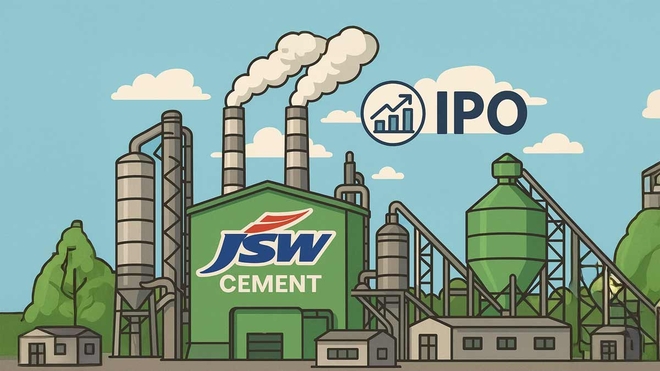 Nitin Yadav/AI-Generated Image
Summary: Considering applying for JSW Cement IPO? The company, part of the Sajjan Jindal-led JSW Group, is positioning itself as a serious player in India’s cement industry with a focus on green cement and an integrated business model. But aggressive capacity expansion, high debt and a lack of profitability are risks that warrant attention. We break them down in the story below. JSW Cement IPO opens for subscription on August 7, 2025 and closes on August 11, 2025. It consists of a fresh issue of Rs 1,600 crore and an offer for sale (OFS) of Rs 2,000 crore by private equity investors and SBI. We break down the company’s business, financials, strengths, risks and valuation to help you make an informed decision. What the company does JSW Cement is one of the fastest-growing cement companies in India, with a total production capacity of 20.6 million tonnes per year as of March 2025. It aims to more than double this to 50 million tonnes by FY30, expanding into new regions to become a pan-India player. The company runs a fully integrated model, meaning it controls almost every part of the production process, from making clinker (a key ingredient in cement) to grinding, running its own power plants (including solar and waste heat recovery). It also owns key logistics infrastructure like rail sidings and port terminals, which help reduce transport costs, a big expense in this industry. What sets it apart is its focus on green cement. It mainly produces blended cements like PSC, PPC and PCC, which are less polluting because they use less clinker. In FY25, 65 per cent of cement sales came from these eco-friendly products, while another 41 per cent came from GGBS, a slag-based byproduct sourced from JSW Steel. This lowers its carbon footprint, which is crucial as customers and regulators push for greener construction materials. Past track record and valuation Financially, JSW Cement’s performance in recent years has been underwhelming in line with the sector’s due to lower realisations and high competition. Over FY23–25: Revenue growth was flat, declining 0.2 per cent annually. FY25 ended in a loss of Rs 114 crore, reversing profits made in previous years. Return on equity (ROE) averaged just 1.7 per cent and ROCE (return on capital employed) came in at 8.2 per cent. At the upper end of the price band (Rs 147), the company is valued at 5.1 times its book value. Sinc
 New episodes every Friday















 New Process Alert
 Seems like you've uploaded a wrong QR code. Please upload the QR code downloaded from MF Central platform.


