 Widely read:


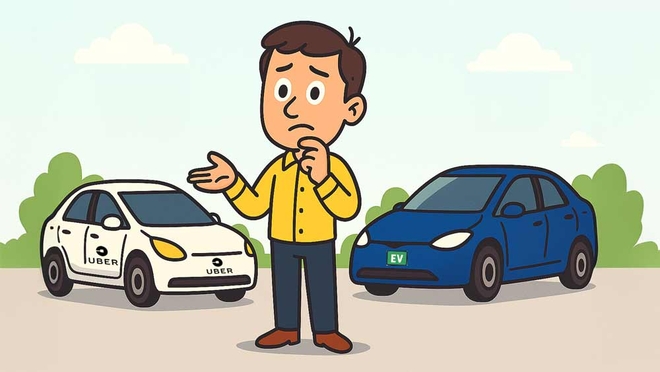 Nitin Yadav/AI-Generated Image

I recently moved into a new home — a bit more space, better view... and 20 km away from my office.
That’s 40 km of daily commute staring at me. Suddenly, the question hit me: Should I buy a car? Go electric? Or just stick to Uber/Rapido?
To figure this out, I crunched the numbers.
Turns out, the difference over 10 years is shocking.
Option 1: Petrol car cost for 10 years
Actual cost of the car: Rs 10 lakh
| Money paid upfront | Rs 2 lakh | Paid 20% of the total car cost (Rs 10 lakh) |
| Loan taken (Rs 8 lakh at 9% for 5 years) | Total loan cost: Rs 9.95 lakh | EMI of Rs 16,596 |
| Fuel cost | Rs 8.1 lakh | ▸ Daily drive: 40 km▸ Days gone to office in a year: 220 ▸ Average mileage: 12 km/litre ▸ Petrol: Rs 110/litre average over 10 years, considering petrol prices grew 4-5% between 2015 and 2025 in Delhi |
| Maintenance | Rs 1.6 lakh | Annual service, repairs, etc., start around Rs 12,000/year, grows with 5.5% inflation annually |
| Insurance (Year 1) | Rs 40,000 | First-year premium is usually higher |
| Insurance (Years 2-10) | Rs 1.8 lakh | Anticipating Rs 20,000 average premium per year for next nine years |
| Miscellaneous | Rs 1 lakh | Parking fees, cleaning fees, etc. |
| Resale value | Rs 3 lakh | Cars typically lose 70–75% of their value in 10 years |
| Total cost of ownership | Around Rs 21.85 lakh |
Option 2: Electric car cost over 10 years
Actual cost of the car: Rs 10 lakh
| Money paid upfront | Rs 2 lakh | Paid 20% of the total car cost (Rs 10 lakh) |
| Loan taken (Rs 8 lakh at 9% for 5 years) | Total loan cost: Rs 9.95 lakh | EMI of Rs 16,596 |
| Charging |
Rs 1.2 lakh | ▸ Cost/unit: Rs 8 (Avg efficiency: 6 km/kWh) ▸ Daily drive: 40 km▸ Days gone to office in a year: 220 |
| Maintenance | Rs 40,000 | ▸ Starts at Rs 3,000/year, minimal inflation impact because EVs have no engine oil, spark plugs, etc. They have software updates, which are cheaper. |
| Insurance (Year 1) | Rs 45,000 | |
| Insurance (Years 2-10) | Rs 2 lakh | Premiums are marginally higher for EV cars |
| Battery replacement (Optional) | Rs 1.75 lakh |
If the battery degrades after 8–10 years, this could be an added cost |
| Miscellaneous | Rs 1 lakh | Parking charges, cleaning fees, etc. |
| Resale value | Rs 3 lakh | EVs still depreciate but may hold better resale value due to rising adoption |
| Total cost of ownership | Around Rs 15.75 lakh |
Option 3: Daily Uber/Rapido
| Total travel cost | Around Rs 19.7 lakh | ▸ Daily fare: Rs 680 (40 km x Rs 17/km)▸ Office days: 220 days▸ Annual fare hike: 6% |
Snapshot of Petrol vs EV vs Cab cost over 10 years
| Petrol | EV | Cab (Uber/Rapido) |
|---|---|---|
| Rs 21.85 lakh | Rs 15.75 lakh | Rs 19.7 lakh |
| *Approximate figures | ||
Pros and cons of each mode
Petrol car (Most expensive)
- Pros: Widespread refuelling network, no range anxiety, strong resale, larger car than an EV model
- Cons: Highest running cost, inflation impact on fuel and maintenance, pollution
EV car
- Pros: Lowest fuel and upkeep cost, eco-friendly, government support rising, you can avoid paying upfront money due to the availability of green loans
- Cons: Higher upfront cost, charging infra still evolving, possible battery replacement, smaller car compared to a petrol car
Cabs
- Pros: Zero ownership burden, no maintenance or insurance, fully flexible
- Cons: Surge pricing, wait times, service reliability, no asset built
What do the numbers tell us?
The numbers make one thing clear: Petrol vehicles are the most expensive over 10 years. While cabs appear cheapest, they come at the cost of convenience and control.
EVs strike the best balance between long-term savings and asset ownership. And with falling battery costs and rising resale values, their appeal will only grow.
But let’s be honest. This isn’t just about math. It’s about how you want to live your life.
Do I want the certainty and pride of owning a car — or the freedom of not worrying about EMI, parking and insurance?
I’m still weighing that for myself. And maybe you should, too.
Look at your lifestyle, your cash flows, and what matters most to you — convenience, cost, control and sanity.
It’s easy to go with what feels aspirational, but sometimes, the smartest move is the one that feels right for you.
Let that be your compass as you decide your next move.
Also read: Did you know even Rs 50 lakh+ earners are struggling to save?
This article was originally published on June 18, 2025.
Disclaimer: This content is for information only and should not be considered investment advice or a recommendation.
For grievances: [email protected]
Ask Value Research 
 New episodes every Friday











 New Process Alert
 Seems like you've uploaded a wrong QR code. Please upload the QR code downloaded from MF Central platform.


