 Widely read:


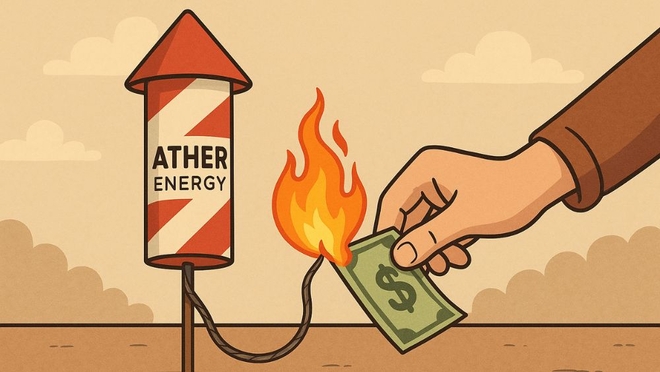 AI-generated image

In India's electric two-wheeler race, two companies have dominated headlines: Ola Electric and Ather Energy . Both were born of the same promise—to reinvent urban mobility—but have taken markedly different routes to get there. One chose velocity over precision. The other opted for patience and polish.
Now, with Ather's Rs 2,981 crore IPO hitting the market, investors are eyeing a second chance. After Ola's post-IPO wobble, can Ather deliver where its flashier rival faltered? Ather may appear more considered and capital-efficient, but a closer inspection reveals familiar red flags, just better disguised.
What Ather gets right
Let's start with the positives, because there are some. On quality, Ather comfortably outpaces Ola. Its JD Power ratings show only 80 problems per 100 vehicles—far better than Ola's 90, though still behind ICE veterans like TVS and Bajaj . Its warranty costs (2.5 per cent of revenue) are materially lower than Ola's 5.9 per cent.
Ather leads EV quality, but ICE giants still rule
With fewer defects per 100 vehicles, Ather edges out Ola but trails behind veterans like TVS and Bajaj
| PP100 | Warranty cost as a% of revenue | |
|---|---|---|
| Royal Enfield | 65 | 0.3 |
| TVS | 75 | 0.2 |
| Bajaj Auto | 78 | 0.1 |
| Ather | 80 | 2.5 |
| Ola Electric | 90 | 5.9 |
| Hero MotoCorp | 98 | 0.7 |
| PP100: problems per 100 vehicles | ||
Operationally, Ather runs a leaner ship. It outsources most components, has stayed out of the capital-heavy battery cell game, and avoids owning showrooms. And crucially, its EV tech is home-grown, not bought off the shelf.
So far, so impressive. But investing isn't about applauding design decisions. It's about making money.
Where the wheels start to wobble
Ather may be tidier, but its business fundamentals are less pristine. Since FY19, it has burnt through Rs 3,400 crore and continues to operate at a loss. Operating profit for the trailing twelve months ending December 2024 stands at - Rs 811 crore. Profit after tax? - Rs 861 crore. The company says its cash burn rate is better than Ola's (0.6 vs 0.7), but only if you start counting from the year revenue began. R&D expenses before 2019 are conveniently excluded.
The bigger problem is capacity utilisation, which is stuck at 39 per cent. Yet, the company plans to double its production capability—a brave move when utilisation is this poor.
Gross margins, excluding subsidies, have just turned positive (12 per cent). Ather attributes this to better operating leverage and a cheaper model mix (notably, the Rizta), but margins without real volume traction can be as temporary as a subsidy scheme.
Rizta drags down unit revenue
Despite premium branding, Ather's revenue per unit has slipped, reflecting its push into mass-market segments.
| FY22 | FY23 | FY24 | 9M FY25 | |
|---|---|---|---|---|
| Volumes | 23,402 | 92,093 | 1,09,577 | 1,07,983 |
| Revenue per unit (Rs) | 1,58,192 | 1,55,571 | 1,43,333 | 1,29,001 |
| Cost of good sold per unit (Rs) | 1,64,003 | 1,73,238 | 1,48,918 | 1,21,584 |
| Gross margin excl. subsidies (%) | -17 | NA | -6 | 12 |
The break-even mirage
Can Ather reach operating profitability? Mathematically, yes. Realistically, it's complicated.
Ather's tough path to break-even
To break even, Ather must sell 6.5 lakh units--nearly 5x current volumes--requiring steep, sustained growth
| Expenses | Current cost* | Assumed cost | Assumption |
|---|---|---|---|
| Employee cost (Rs cr) | 400 | 700 | Due to scale build up |
| Other expenses (Rs cr) | 500 | 700 | As scale builds up, warranty cost and marketing spends will increase |
| Depreciation (Rs cr) | 170 | 300 | Considering the current expansion of assembly lines |
| *Annualised on 9M FY25 numbers | |||
Assuming a healthy 20 per cent gross margin, the company would still need to sell 6.5 lakh units a year to break even at the operating level—nearly five times its current run rate. That implies a 37 per cent annual growth rate over five years—double what it achieved in the last two, and that too during an incentive-heavy phase for EVs.
This isn't impossible. But in a sector already crowded with ICE incumbents and EV upstarts, it's a tall order.
The brand goes mass-market—but can it stick?
Much of Ather's recent volume growth comes from Rizta, a lower-priced, mass-market offering. While Rizta now accounts for 50 per cent of sales, its success raises a brand conundrum.
Ather's appeal was always strongest among tech-savvy urban consumers. But the mass market is ruled by different rules—price, reach and trust. Will customers in Patna or Indore choose an upstart over an Activa from Honda?
There's also a geographical challenge. Ather's sales are concentrated in South India. Expanding nationally means building out infrastructure, marketing and after-sales, all of which require capital. And time.
What's in the IPO war chest?
From the Rs 2,626 crore fresh issue, Ather plans to spend Rs 927 crore on capex, Rs 750 crore on R&D, and Rs 300 crore on marketing over the next three years.
Can the IPO funds stretch far enough?
With modest budgets compared to rivals, Ather's expansion ambitions could face a resource crunch
| Allocation | Total IPO proceeds | FY26 | FY27 | FY28 |
|---|---|---|---|---|
| Capex | 927 | 706 | 221 | - |
| R&D | 750 | 270 | 265 | 215 |
| Marketing | 300 | 150 | 150 | - |
| Source: IPO prospectus | ||||
But this may not go far enough. The Rs 150 crore annual marketing budget looks modest in a market where incumbents spend over Rs 1,000 crore a year, with established brands and networks already in place.
Similarly, the R&D run rate is trending above Rs 300 crore, and is likely to rise in a segment where differentiation will come from design, battery chemistry and software smarts.
Ather may well need another funding round. And when it comes, expect shareholder dilution.
The missing moat
Strip away the polish, and a more fundamental question emerges: what moat does Ather have?
Its technology is credible, but replicable. Its capital-light model is efficient, but lacks vertical integration advantages. Its premium brand could lose its edge as it goes mass. And its network is regional, not national.
In short, Ather has no wide or durable moat. Not yet. In a sector where rivals are investing aggressively and foreign brands loom large, that's a strategic weakness.
Valuation: an expensive leap of faith
At the upper end of the price band (Rs 321), Ather will list with a market capitalisation of nearly Rs 12,000 crore, on zero profits and a price-to-book ratio of 4.4x. There's no P/E because there's no E.
The company would need to generate at least Rs 400 crore in annual operating profit just to justify that valuation, and that too at a generous 30x multiple. That's a stretch in the near term, particularly when losses remain heavy and margins untested.
Investors are being asked to pay up for potential, but with no guarantee that potential turns into performance.
Final word: Smarter than Ola, but not investment-ready
To its credit, Ather looks more mature than Ola Electric. It's measured in its growth, better at quality control, and more thoughtful in capital allocation. But that's not the same as being investment-ready.
Margins remain thin. Losses are persistent. Breakeven is distant. And the road to scale—geographically and operationally—is paved with uncertainty.
Investors looking for a clean EV play may find Ather more refined. But refinement doesn't pay the bills. Profits do.
Until Ather proves it can scale profitably without repeat dilutions, its IPO is best seen not as a second chance, but as a cautious wait-and-watch.
Looking for deeper stock insights?
Assessing a company like Ather Energy takes more than just headlines—it demands careful analysis of fundamentals, management quality, and valuation. With Value Research Stock Advisor , you get expert recommendations backed by rigorous research, helping you identify quality stocks and avoid costly mistakes.
Stay ahead of the market—explore Stock Advisor today and invest with greater confidence.
Also read : Why IDFC First Bank keeps asking for more capital
This article was originally published on May 03, 2025.
Disclaimer: This content is for information only and should not be considered investment advice or a recommendation.
For grievances: [email protected]
Ask Value Research 
 New episodes every Friday











 New Process Alert
 Seems like you've uploaded a wrong QR code. Please upload the QR code downloaded from MF Central platform.


