 Widely read:


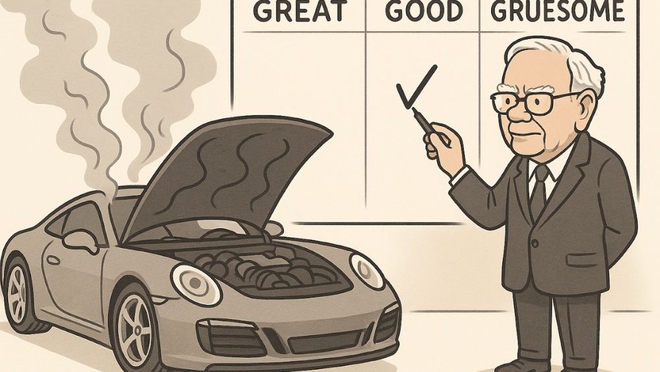 AI-generated image
Most businesses don't die with a bang. They just quietly rot from the inside. You don't see it in a single quarter or even a single year. But give it time—and the decay becomes impossible to ignore. That's why Buffett keeps returning to one simple idea: return on capital. Not revenues. Not growth. Not "transformational vision." Just this: how much does a business earn relative to what it needs to keep running and growing? This was the basis of Buffett's investing framework laid out in his 2007 letter. The framework, which separates businesses into three kinds—great, good and gruesome—is so elegant and useful that it deserves a place in every investor's toolkit. The letter also goes into how to actually evaluate investment performance when the market is shouting at you every day. We have unpacked it all in this story, a part of our series on Buffett's annual letters. The art of picking a business Investors love to obsess over business models. And why wouldn't they? It's fascinating to analyse how a company makes money, scrutinise its growth prospects and find out its uniqueness. But knowing the business model is not enough. What you need to understand first is the economics of the business. Buffett's framework of the great, the good and the gruesome businesses is an antidote to this obsession with business models. Stop getting lost in the glamour of a company's product or service. Instead, look under the hood. Ask yourself: what kind of returns does this business generate? How much capital does it require to grow? And what does that mean for you, the investor? The great business A great business is more than a clever idea or an iconic product-it's an economic engine that compounds wealth with minimal effort. Buffett's See's Candies is the perfect example. See's sells chocolates but what makes it great is not the product-it's the numbers. Since its acquisition in 1972, See's has required just $32 million in additional capital to grow pre-tax profits from $5 million to $82 million (2007). Meanwhile, it has sent $1.35 billion in pre-tax profits to Berkshire Hathaway. The greatness of See's Candies Particulars Value
This article was originally published on April 26, 2025.

 New episodes every Friday










 New Process Alert
 Seems like you've uploaded a wrong QR code. Please upload the QR code downloaded from MF Central platform.


