 Widely read:


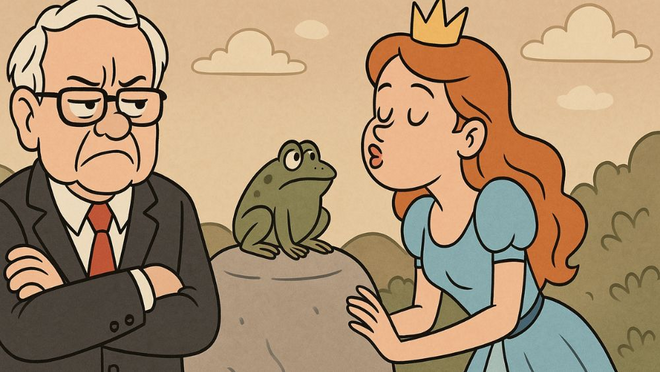 AI-generated image
In his 1992 letter, Warren Buffett pulls no punches. He skewers the vanity, delusion, and fuzzy thinking that drive so many corporate decisions, from overpaying for mediocre businesses to mislabelling speculation as "value investing." This missive is not just a critique of bad capital allocation. It's a warning: the cost of kissing too many toads is paid by shareholders, not CEOs.
This story is part of our ongoing series unpacking Buffett's letters to shareholders and his 1992 letter, in particular, is a masterclass in clear thinking, capital discipline, and knowing the difference between price and value.
The trouble with toads
Buffett's problem is not with acquisitions per se. It's with the way many managers go about them — impulsively, expensively, and repeatedly. Some are so mesmerised by the idea of transformation that they overpay for weak businesses, then try to fix them with enthusiasm and a line of restructuring charges. The result? A pile of toads and a tuition bill footed by shareholders.
It's not hard to see why this happens. As George Santayana put it, fanaticism is "redoubling your effort when you have forgotten your aim." That's corporate acquisition mania in a nutshell.
Value and growth are not opposites
From fairy tales, Buffett moves on to fuzzy thinking, in particular, the false divide between value investing and growth investing. He is blunt and says that the two are joined at the hip. Growth is just one component in the equation of value. In some cases, it's minor. In others, it's everything. But there is no such thing as value investing that doesn't consider growth, just as there is no such thing as investing without considering value. That would be speculation.
The confusion, Buffett suggests, comes from overreliance on simple heuristics like low P/E or low price-to-book. Those can be signals, but they are not proof. Plenty of "value" stocks are simply cheap for a reason. And plenty of expensive-looking stocks are actually terrific value if their underlying business earns high returns on capital and can reinvest at those rates.
When growth hurts
To really grasp value, Buffett insists, you have to distinguish between growth that adds value and growth that destroys it. The airline industry is his cautionary tale. Decades of capital has flown into the industry, financing impressive growth in passenger volume and aircraft fleets — all for barely any profit. Growth, in this case, was not a sign of strength. It was a symptom of capital destruction.
Growth is only good when the returns on the incremental capital are high. Otherwise, it's just a bigger bonfire of shareholder money.
The universal formula
At the heart of Buffett's framework is a simple equation, first laid out by economist John Burr Williams in 1938: the value of any asset is the present value of its future cash flows.
It's as true for stocks as for bonds. But with bonds, you get coupons and maturity dates. With equities, you get unknowns and that is where all the challenge lies. The real work is in estimating those future "coupons" and in assessing whether management can keep them flowing.
So what makes for a great business? According to Buffett, one that can deploy large amounts of capital at high returns, over a long period of time. Simple to say, rare to find.
And what makes for a terrible business? One that soaks up capital only to deliver mediocre or low returns. Worse still are businesses that must reinvest heavily just to stand still. Think utilities, airlines, or legacy industrials stuck in a cycle of capex and competition.
Know what you don't know
Buffett also lays out a humble approach to navigating all this uncertainty. First, stick to what you understand. If a business is too complex or too subject to technological change or regulatory uncertainty, Berkshire avoids it. No shame in that. In fact, the discipline to say "I don't know" is what separates investors from gamblers.
Second, demand a margin of safety. If a business looks like it's worth Rs 100, and the market price is Rs 95, it's not good enough. The calculation might be wrong. The assumptions might be off. Something unknown might be about to change. So unless there is a big enough gap between value and price — a real buffer — the investment is not worth the risk.
Final word
Buffett's 1992 letter is about not overcomplicating things. Investing is not about fancy labels or clever narratives. It's about paying less than something is worth and knowing, within reason, what it's worth in the first place.
Growth matters. So does the price. But what matters most is the discipline to wait, the humility to admit what you don't understand, and the clarity to distinguish between investment and speculation. Or, to put it another way, the game is not about finding toads to kiss. It's about not mistaking them for princes in the first place.
Also read: Gems in the rubble
This article was originally published on April 08, 2025.
Disclaimer: This content is for information only and should not be considered investment advice or a recommendation.
For grievances: [email protected]
Ask Value Research 
 New episodes every Friday











 New Process Alert
 Seems like you've uploaded a wrong QR code. Please upload the QR code downloaded from MF Central platform.


