 Widely read:


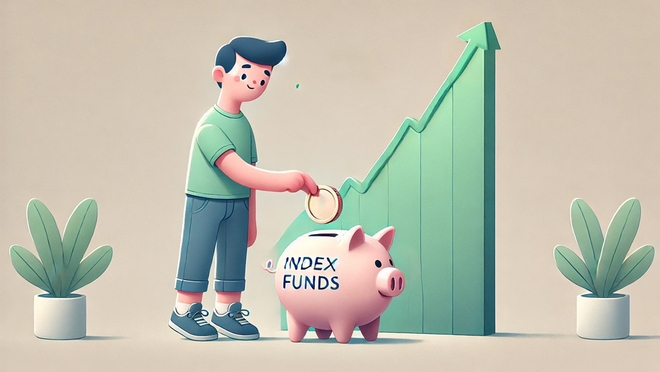 AI-generated image
What if investing could be simple, low-cost, and stress-free while still delivering strong long-term returns? For many investors, index funds have become the perfect solution. Instead of picking individual stocks or relying on fund managers to outperform the market, index funds offer a straightforward way to participate in market growth.
But why are index funds gaining so much attention? The answer lies in their diversification, low cost, and long-term growth potential. Let's explore why they deserve a place in your portfolio.
The key benefits of index funds
Diversification - Spreading risk effortlessly
One of the biggest risks in investing is putting too much money into a few stocks. If one of them underperforms, your entire portfolio suffers. Index funds solve this problem by investing in a broad set of stocks, spreading risk across multiple companies.
For example, a Nifty 50 index fund gives you exposure to 50 of India's top companies. Even if some of these companies underperform, the good performance of the remaining companies reduces the impact of individual stock fluctuations.
In contrast, picking individual stocks requires in-depth research and constant monitoring. With an index fund, you automatically get a well-diversified portfolio with minimal effort.
Suggested read: How much to own what?
Low cost - Keeping more of your returns
Investing is not just about how much you earn but also about how much you keep after fees. Actively managed mutual funds charge higher expense ratios because they employ fund managers and analysts to research and select stocks.
Index funds, on the other hand, follow a passive strategy, simply tracking a stock market index. This reduces fund management costs, making expense ratios significantly lower than actively managed funds.
Over time, these cost savings add up, allowing you to keep more of your investment returns. In the long run, a lower expense ratio can make a huge difference in your final wealth accumulation.
Suggested read: How expense ratio eats into your mutual fund gains
Long-term growth - Riding the market
Stock markets go through ups and downs, but history shows that they tend to grow over time. By investing in an index fund, you benefit from this long-term growth without needing to predict market movements.
Consider this: over the past few decades, the Nifty 50 and Sensex have delivered strong returns despite short-term volatility. Rather than trying to time the market, a buy-and-hold strategy with index funds allows investors to take advantage of the market's overall growth.
Index funds vs. actively managed funds
Performance comparison
Many investors assume that actively managed funds, led by experienced fund managers, will always outperform index funds. However, data suggests otherwise.
Studies show that most actively managed large-cap funds fail to beat the market in the long run. After accounting for fund management fees and trading costs, many active funds struggle to justify their higher expense ratios.
A 2024 S&P Indices versus Active (SPIVA) report shows that over 70 per cent of Indian equity large-cap active funds underperformed the benchmark over the last 10 years (as of June 30, 2024). That number rises to 87 per cent for the five-year horizon. Similarly, more than 40 per cent of Indian equity mid- and small-cap active funds underperformed the benchmark in the last five years and 10 years.
This highlights the challenge of consistently selecting winning stocks.
Simplicity vs. constant monitoring
Investing in actively managed funds requires effort - you need to track fund manager decisions, review fund performance, and possibly switch funds if they underperform.
Index funds, in contrast, are a set-and-forget investment. Since they track the market automatically, you don't need to worry about fund manager changes, strategy shifts, or stock-picking mistakes.
Risk and consistency
Actively managed funds rely on the skills of fund managers. Some perform well, but others don't, and there's no guarantee that a star fund manager today will continue to outperform tomorrow.
Index funds, however, offer consistent market exposure. Instead of betting on fund managers, you invest in the broader market, which has historically delivered positive long-term returns.
Who should consider investing in index funds?
Index funds are ideal for:
- Beginners: Those new to investing who want a simple and effective way to start.
- Long-term investors: Those who believe in wealth creation through steady market growth.
- Cost-conscious investors: Those who want to minimise fees and maximise returns.
- Passive investors: Those who prefer a low-maintenance investment approach without frequent monitoring.
Conclusion
Index funds provide a powerful combination of diversification, cost efficiency, and long-term growth. They take the stress out of investing while delivering market-matching returns.
Instead of trying to beat the market, wouldn't it be smarter to invest in the market itself? With a proven track record and lower costs, index funds could be the foundation of a successful investment strategy.
An investor education and awareness initiative of Nippon India Mutual Fund.
Helpful Information for Mutual Fund Investors: All Mutual Fund investors have to go through a one-time KYC (know your Customer) process. Investors should deal only with registered mutual funds, to be verified on SEBI website under 'Intermediaries/Market Infrastructure Institutions'. For redressal of your complaints, you may please visit www.scores.gov.in For more info on KYC, change in various details and redressal of complaints, visit mf.nipponindiaim.com/InvestorEducation/what-to-know-when-investing
Mutual fund investments are subject to market risks, read all scheme related documents carefully.
Also read:
What are index funds?
The basics of market indices
This article was originally published on March 10, 2025.
Disclaimer: This content is for information only and should not be considered investment advice or a recommendation.
For grievances: [email protected]
Ask Value Research 










 New Process Alert
 Seems like you've uploaded a wrong QR code. Please upload the QR code downloaded from MF Central platform.


