 Widely read:


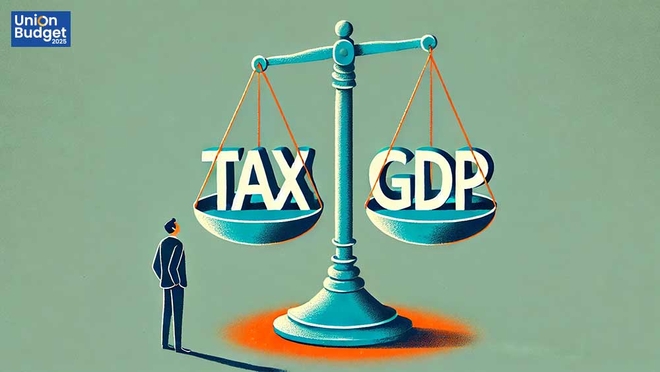

Ever wondered how well India is turning its massive economy into actual tax revenue? That's where the tax-to-GDP ratio steps in — a simple but powerful metric that shows how much of the nation's income comes from taxes. Think of it as a fiscal report card for the government. The higher the score, the better it's doing at mobilising resources for development. So, how's India faring? Let's break it down.
What is the tax-to-GDP ratio?
Imagine your household budget. Your income (tax revenue) covers expenses like groceries, rent, and savings (GDP). Now, picture how efficiently you're earning compared to how much you're spending. That's essentially the tax-to-GDP ratio — a measure of how well the government collects taxes relative to the size of the economy.
A higher ratio means the government has more funds to spend on roads, schools, and hospitals without borrowing itself into a hole. A lower ratio? That's like living paycheck to paycheck, with no room for growth.
Why does it matter?
Because the tax-to-GDP ratio is the backbone of public spending. For example, India's projected tax revenue for 2024-25 is Rs 38.4 lakh crore, with GST alone contributing over Rs 10.6 lakh crore. These funds fuel essential projects, from infrastructure to healthcare, without leaning too hard on debt.
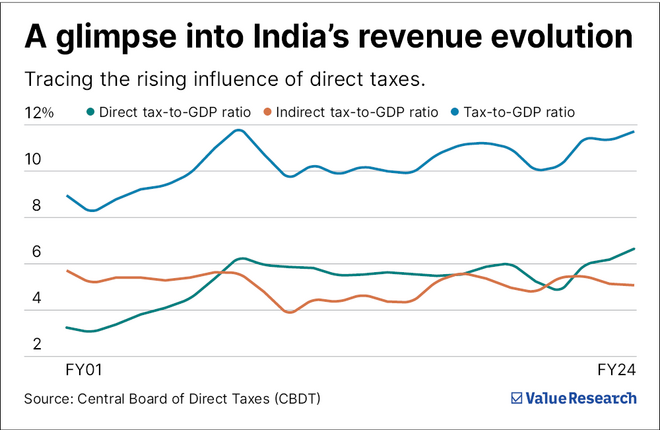
India's tax-to-GDP ratio has climbed from 10 per cent in the 2010s to 11.8 per cent in 2024-25, showing improvement but still lagging behind developed economies, where it's often over 30 per cent. The goal? To collect more without squeezing taxpayers dry.
The challenge of low ratios
India's tax-to-GDP ratio has historically struggled due to tax evasion, a large informal sector, and narrow tax bases. For perspective, only 6.5 crore Indians filed income tax returns in FY 2023-24, despite the country's 140 crore-plus population. Compare that to developed nations, where compliance rates are much higher.
The global average tax-to-GDP ratio is around 15-20 per cent for developing countries and 25-35 per cent for advanced economies. While India has made progress, challenges like expanding the tax base and improving compliance remain key hurdles.
A blast from the past
Back in 1991, India's tax-to-GDP ratio was stuck at around 10 per cent. Rigid tax structures and low compliance didn't help. Enter the economic reforms of the 1990s — tax slabs were rationalised, Value-Added Tax (VAT) was introduced, and indirect taxes became more streamlined. The launch of Goods and Services Tax (GST) in 2017 further simplified things, giving the ratio a much-needed boost.
What's next for India's tax-to-GDP ratio?
Boosting the ratio requires a multipronged approach:
- Expanding the tax base: Encourage more businesses and individuals to file taxes.
- Leveraging technology: Use AI and data analytics to track evasion and improve compliance.
- Widening GST coverage: Bring more goods and services under the GST umbrella.
These steps will not only increase revenue but also reduce fiscal deficits and build public trust in the system.
Closing thoughts
The tax-to-GDP ratio isn't just a boring number — it's the pulse of the nation's fiscal health. It shows how efficiently the government is converting economic activity into resources for public welfare. With steady improvements and the right reforms, India's ratio reflects a maturing economy ready to tackle developmental challenges.
Next time someone drops the "tax-to-GDP ratio" into a conversation, you'll have plenty of analogies to explain why it matters — and maybe even inspire a debate on how to improve it!
Keep playing "Budget Lingo"
Revisit the previous term: Primary deficit: Is the government borrowing wisely?
Learn the next term: Revenue receipts: The salary that keeps India running
Stay with us as we continue to decode the terms that demystify India's Union Budget.
Disclaimer: This content is for information only and should not be considered investment advice or a recommendation.
For grievances: [email protected]
Ask Value Research 
 New episodes every Friday









 New Process Alert
 Seems like you've uploaded a wrong QR code. Please upload the QR code downloaded from MF Central platform.


