 Widely read:




Revenue deficit measures whether the country's regular income can cover its daily expenses — like salaries, pensions, and subsidies — or if it's borrowing to make ends meet. Imagine a household earning Rs 50,000 a month but spending Rs 60,000 on essentials. That Rs 10,000 shortfall might not seem like a big deal initially, but over time, it could sink their dreams of saving for a house or sending the kids to college. Similarly, a revenue deficit highlights when the government's income falls short of its operational costs, leaving it to borrow not for growth, but for day-to-day survival.
What is revenue deficit?
In plain terms, revenue deficit happens when the government's revenue expenditure (like subsidies and interest payments) exceeds its revenue receipts (taxes and other earnings). Unlike fiscal deficit, which considers both revenue and capital spending, revenue deficit zooms in on the core question: Is the government living within its means?
For instance, if the government earns Rs 10 lakh crore from taxes but spends Rs 12 lakh crore on subsidies and salaries, it's staring at a Rs 2 lakh crore revenue deficit. Borrowing to plug this gap doesn't just hurt savings — it also eats into funds that could've built roads, schools, or hospitals.
Why should you care about revenue deficit?
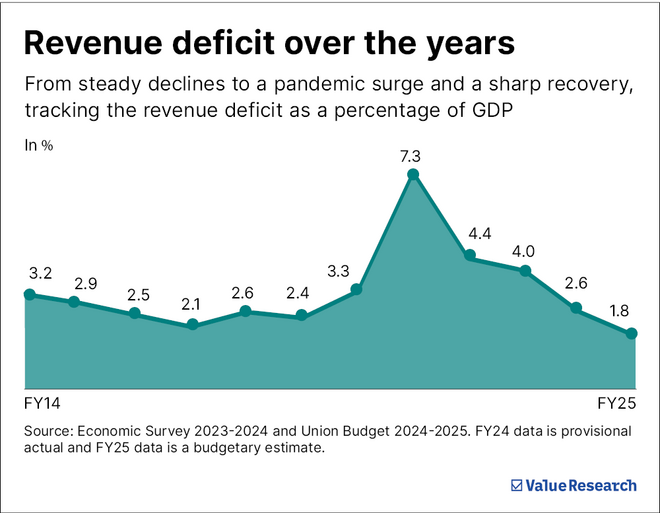
Because it's like a doctor's report for the economy. A persistently high revenue deficit signals that the government is borrowing just to keep the lights on, which isn't great for long-term financial health. For the fiscal year 2024-25, India's revenue deficit is pegged at Rs 5.80 lakh crore (1.8 per cent of GDP) — a big improvement from 4 per cent in 2022-23. This shows the government is tightening its belt and spending smarter.
Revenue deficit: A lesson from history
The 1991 Balance of Payments crisis put revenue deficit in the spotlight. India faced an economic meltdown, with dwindling reserves and mounting debt. This moment of reckoning led to sweeping reforms and put fiscal discipline at the centre of Budget conversations. Since then, revenue deficit has become a key metric to gauge a government's financial prudence.
How to decode revenue deficit like a pro
Here's what to watch for:
- Deficit-to-GDP ratio: At 1.8 per cent for 2024-25, India's ratio shows steady progress towards fiscal discipline.
- Purpose of borrowing: Borrowing for infrastructure? Good. Borrowing to cover subsidies and salaries? Not so great.
Closing thoughts
Revenue deficit isn't just a number — it's a reality check for the government's financial habits. While occasional deficits can be strategic, a habit of overspending on daily operations can crowd out funds for growth and development. Over the years, initiatives like rationalising subsidies, improving tax compliance, and privatisation have helped rein in the deficit while supporting the economy's growth ambitions.
Next time you see "revenue deficit" in Budget headlines, dig deeper. It's not just about numbers — it's about how well the government is managing its purse strings while steering the nation towards prosperity. And who knows, you might end up schooling your friends on the real story behind those fiscal figures!
Keep playing "Budget Lingo"
Revisit the previous term: What is fiscal deficit?
Learn the next term: Primary deficit: Is the government borrowing wisely?
Stay with us as we continue to decode the terms that demystify India's Union Budget.
Disclaimer: This content is for information only and should not be considered investment advice or a recommendation.
For grievances: [email protected]
Ask Value Research 
 New episodes every Friday









 New Process Alert
 Seems like you've uploaded a wrong QR code. Please upload the QR code downloaded from MF Central platform.


