 Widely read:




Imagine running a household where you must plan for groceries, rent, and school fees, all while saving for the next family vacation. Now, picture scaling that up to a country of 1.4 billion people. Sounds daunting? That's where the Union Budget comes in - it's essentially India's financial plan for the year. Whether it's funding defence, building highways, or deciding how much tax you'll pay, the Budget touches every corner of the nation - and yes, it has a direct impact on your life, too.
What is the Union Budget?
Think of it as the government's annual "money diary." It's not just numbers - it's a big deal. The Budget tells us how the government will spend on things like schools, hospitals, and roads, and how much it'll collect from taxes. Plus, it's the master plan for tackling big issues like job creation, inflation, and infrastructure growth.
And just like your personal budget, it has two parts:
- Revenue budget: The "day-to-day" stuff - salaries, subsidies, and the like.
- Capital budget: The "big-ticket" stuff - building highways, power plants, and other long-term investments.
Why should you care?
Great question! Because it affects almost everything you care about - taxes, petrol prices, your startup's funding prospects, and even the price of your favourite Maggi packet.
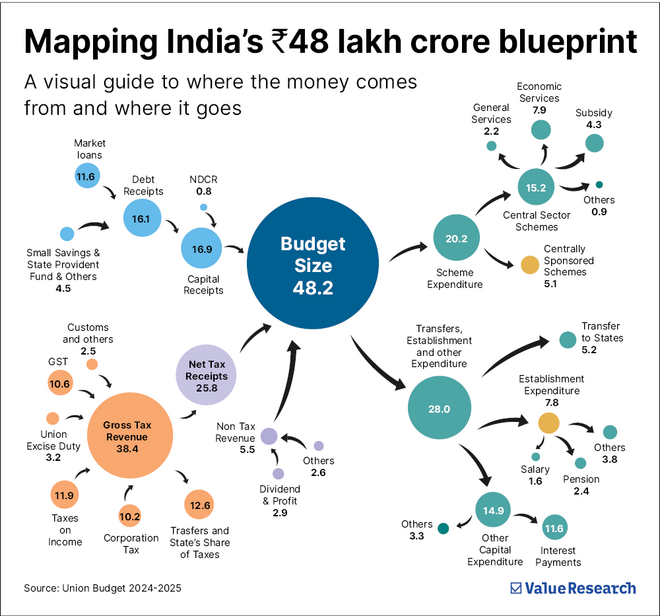
For instance, in the Union Budget 2024-2025, the government allocated a whopping Rs 48.2 lakh crore. Out of this, Rs 11.1 lakh crore was set aside for capital investments - a 17 per cent jump from the previous year. Translation: More jobs, better infrastructure, and hopefully fewer potholes.
The Budget in three quick parts
Understanding the Budget may seem daunting, but breaking it into parts helps:
- Receipts: This is the government's "income" bucket, which includes taxes (think GST and income tax) and non-tax revenues like dividends from public sector companies.
- Expenditure: This is the "spending" bucket, divided into revenue expenditure (e.g., paying salaries) and capital expenditure (e.g., building a new highway).
- Deficit: When the government spends more than it earns, it ends up in the red. This is called the fiscal deficit, which means it has to borrow to make up the difference.
Sounds familiar? Turns out, the government and most of us have something in common: the need for a little extra cash now and then.
A blast from the Budget past
Did you know the concept of the Union Budget in India dates back to British rule? The first one was presented in 1860 by James Wilson. Fast forward to 1947, when independent India's first Budget was tabled by R. K. Shanmukham Chetty. It was a short speech (just 15 minutes!), focusing on stabilising an economy recovering from Partition.
Fun fact: Until 2000, Budgets were presented at 5 PM, a leftover tradition from the British, so they could tune in comfortably from London.
How the Budget has evolved
Gone are the days of handwritten Budget documents (imagine the paper cuts!). Today, it's all digital, complete with live streaming. Early Budgets focused on food shortages and basic infrastructure, while recent ones tackle futuristic goals like green energy and digital transformation.
Take the 1991 Budget by Dr Manmohan Singh - it kickstarted India's liberalisation. Or the 2023 Budget, which allocated Rs 19,700 crore to the National Green Hydrogen Mission, putting India on the map for renewable energy innovation.
A nation's financial pulse
The Union Budget isn't just a bunch of boring numbers - it's the heartbeat of the nation. It tells us where we're headed, what's important, and how we plan to get there. From a farmer to a techie, everyone feels its impact.
So, the next time Budget Day rolls around, don't just scroll past the headlines. Dive in - it's not just about the economy; it's about how India plans to grow, innovate, and thrive. And who knows? You might even drop a fact or two at your next party and steal the show.
Kickstart your "Budget Lingo" journey
This is your first step in decoding the jargon that shapes India's budget discourse.
Discover the next term: What is fiscal deficit?
Stay tuned as we simplify the language of the budget, one term at a time.
Disclaimer: This content is for information only and should not be considered investment advice or a recommendation.
For grievances: [email protected]
Ask Value Research 
 New episodes every Friday









 New Process Alert
 Seems like you've uploaded a wrong QR code. Please upload the QR code downloaded from MF Central platform.


