 Widely read:


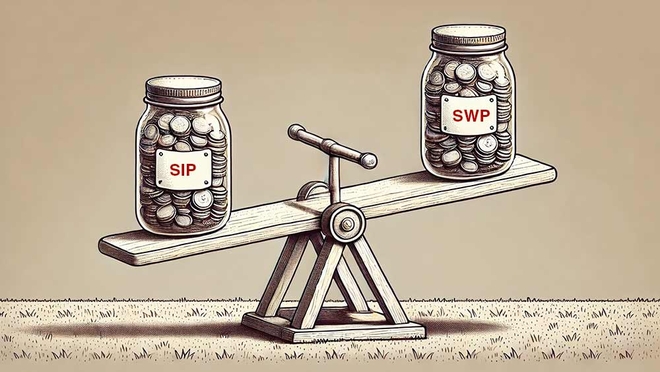 AI-generated image
Mutual funds have become a reliable way to build wealth over the long term. They offer investors the flexibility to automate their investments and withdrawals, ensuring financial discipline and steady cash flow. Through Systematic Investment Plans (SIPs), you can grow your wealth over time, while Systematic Withdrawal Plans (SWPs) allow you to withdraw funds periodically.
In this article, we'll cover the basics of these two investment mechanisms and help you figure out how they are different from one another.
What is an SIP?
A Systematic Investment Plan (SIP) is an investment approach where a fixed amount is invested in mutual funds at regular intervals, such as monthly or quarterly. This disciplined strategy helps investors avoid market timing and gradually accumulate wealth.
Rupee cost averaging
One of the key advantages of SIP is rupee cost averaging . By investing a fixed amount regularly, investors buy more units when prices are low and fewer units when prices are high, effectively reducing the overall cost per unit over time.
The power of compounding
SIP allows investors to benefit from the power of compounding , where the returns generated on investments are reinvested, leading to exponential growth over the long term.
Benefits of an SIP
-
No need to time the market:
Investors don't need to
track market movements
to invest via SIPs. Regular investments ensure that, due to rupee cost averaging, the cost of acquisition evens out over time.
-
Streamlined investments:
Automating investments ensures financial discipline and makes wealth accumulation easier.
- Start small: SIPs allow investors to begin with modest amounts, enabling them to build wealth gradually without significant upfront investment.
Common SIP mistakes to avoid
-
Not increasing your SIP amount:
By continuing your SIPs at the same amount for years at end, you slow down your progress towards riches. So, consider
stepping up your SIP
every time you get an increment at work.
- Timing the market: Investors often stop their SIPs when the market is performing well, fearing an overheated market, but this disrupts long-term wealth-building potential.
What is an SWP?
A Systematic Withdrawal Plan (SWP) allows investors to withdraw a fixed amount from their mutual fund investments at regular intervals, such as monthly or quarterly. It is an effective way to create a steady income stream while maintaining the invested corpus.
Suggested read: The power of simple ideas
Benefits of an SWP
-
Regular income stream:
SWPs are ideal for retirees or those seeking periodic income to meet their financial needs.
- Wealth preservation: The remaining investment continues to grow and benefit from compounding, offering a balance between income and long-term growth.
Suggested read: What is the right approach to setting up a systematic withdrawal plan (SWP)?
Common SWP mistake to avoid
- Withdrawing too much: Withdrawing more than 4-6 per cent of the corpus annually may result in depleting the savings prematurely, potentially causing financial insecurity in the future.
Differences between SIP vs SWP
| Systematic Investment Plan (SIP) | Systematic Withdrawal Plan (SWP) | |
|---|---|---|
| Purpose | To accumulate wealth through disciplined investing. | To generate regular income by withdrawing systematically. |
| Objective | Wealth accumulation over time. | Liquidity and steady income. |
| Ideal For | Investors looking to grow wealth gradually. | Investors needing periodic withdrawals, such as retirees. |
| Market Impact | Benefits from market lows by accumulating more units at lower prices (rupee cost averaging). | Benefits from market highs by withdrawing units at higher prices, preserving capital. |
| Suitability | Ideal for long-term goals like retirement, children's education, or wealth creation. | Suitable for post-retirement income, covering regular expenses, or financial planning with fixed payouts. |
Conclusion
SIPs and SWPs can work hand in hand as part of a comprehensive financial plan. SIPs enable disciplined wealth accumulation through regular investments and the benefits of rupee cost averaging. Once investors reach their financial goals, SWPs can provide a steady income stream while allowing the remaining corpus to grow.
To make the most of your investments, it's crucial to understand how to balance growth and withdrawals effectively. Value Research Fund Advisor can guide you in structuring your financial plan to ensure that you are on track to achieving your goals.
How do SIPs work?
A Systematic Investment Plan (SIP) allows you to invest a fixed amount in a mutual fund at regular intervals, such as monthly or quarterly. When you invest through an SIP, your money is used to purchase fund units, and the number of units you get depends on the prevailing Net Asset Value (NAV). SIPs benefit from rupee cost averaging , meaning you buy more units when prices are low and fewer when prices are high, helping to reduce the impact of market volatility. Over time, SIPs help in wealth creation by leveraging the power of compounding.
Suggested read: What is an SIP?
How do SWPs work?
A Systematic Withdrawal Plan (SWP) allows you to withdraw a fixed amount from your mutual fund investment at regular intervals, such as monthly or quarterly. Instead of redeeming your entire investment at once, SWPs help you receive a steady income by selling fund units gradually. The number of units sold depends on the fund's current Net Asset Value (NAV). SWPs work well for those looking to generate regular income while keeping the remaining corpus invested for potential growth. They are commonly used by retirees or individuals seeking financial stability.
Also read: What is an SWP in a mutual fund?
This article was originally published on January 26, 2025.
Disclaimer: This content is for information only and should not be considered investment advice or a recommendation.
For grievances: [email protected]
Ask Value Research 
 New episodes every Friday











 New Process Alert
 Seems like you've uploaded a wrong QR code. Please upload the QR code downloaded from MF Central platform.


