 Widely read:


 AI-generated image

Mutual fund NAVs (net asset value) have puzzled investors for a long time. They are even more puzzled when they witness a mutual fund's NAV go from Rs 10 to Rs 4,000 over time.
This growth is no miracle, though. It's the result of disciplined fund management, compounding and time. Here's how it happens.
What is NAV and why does it start at Rs 10?
NAV represents the per-unit value of a mutual fund's portfolio after deducting liabilities. It is calculated by dividing the total value of the fund's assets by the number of outstanding units.
For instance, if a fund starts with Rs 10 crore in assets and issues 1 crore units, the NAV is Rs 10. As the fund invests in assets like stocks or bonds and their value increases, the NAV rises over time. This growth reflects the appreciation of the fund's portfolio, adjusted for expenses.
When a mutual fund is launched, it typically prices its units at Rs 10 for simplicity and uniformity. This is merely a starting point and does not indicate the fund's future performance.
What drives NAV growth?
- Portfolio appreciation: Mutual funds invest in assets like equities, which typically appreciate over time, pushing the NAV higher.
- Compounding over time: Compounding amplifies returns when investments are held long-term, creating a snowball effect that accelerates NAV growth.
- Reinvestment of earnings: In growth plans, dividends and interest (in the case of debt funds) earned are reinvested, accelerating compounding.
- Efficient fund management: Skilled fund managers optimise portfolio performance through stock selection, timing and rebalancing, which significantly influence NAV growth.
Example of NAV growth
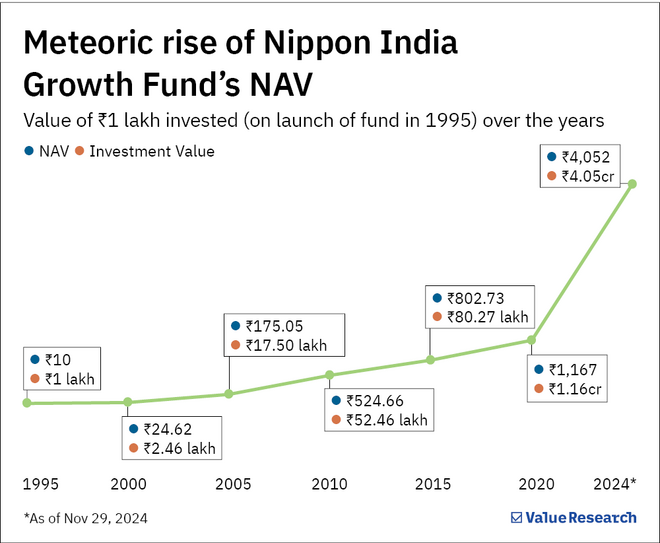
Consider Nippon India Growth Fund, launched in 1995 at an NAV of Rs 10. By November 2024, its NAV had grown to over Rs 4,000, delivering an annualised return of close to 23 per cent.
If an investor had invested Rs 1 lakh at inception:
- Units bought: 10,000 (Rs 1,00,000 ÷ Rs 10)
- NAV as of November 2024: Rs 4,052
- Current investment value: Rs 4.05 crore (10,000 units × Rs 4,052)
This transformation highlights the power of staying invested, compounding, and consistent portfolio growth over time.
Myths about NAV
A higher NAV doesn't mean a fund is expensive. It simply reflects past growth and doesn't impact the fund's potential for future returns.
A lower NAV doesn't mean higher returns. A fund's returns depend on fund performance, not NAV. For instance:
Aditya Birla Sun Life Flexi Cap Fund (NAV: Rs 1,761) has a 5-year SIP return of 21 per cent.
Parag Parikh Flexi Cap Fund (NAV: Rs 82) has a 5-year SIP return of 25 per cent.
Key takeaways for investors
- Time in the market matters: Staying invested through market cycles allows your money to grow and compound.
- Focus on fund quality: Evaluate performance, consistency and the fund manager's track record, not just NAV.
- Reinvest for growth: Growth plans reinvest earnings, accelerating long-term wealth creation.
The journey of a mutual fund's NAV from Rs 10 to Rs 4,000 exemplifies the power of compounding and long-term investing. Rather than focusing on the NAV alone, ask what the fund's performance and management tell you and whether it aligns with your goals.
To make informed investment decisions and track top-performing funds, use Value Research Fund Advisor for expert recommendations and insights.
Also read: All you need to know about mutual funds
Disclaimer: This content is for information only and should not be considered investment advice or a recommendation.
For grievances: [email protected]
Ask Value Research 
 New episodes every Friday











 New Process Alert
 Seems like you've uploaded a wrong QR code. Please upload the QR code downloaded from MF Central platform.


