 Widely read:





Over the years, SIP (systematic investment plan), a feature offered by mutual funds, has become a household name. With a growing interest in SIPs, a few obvious questions come to an investor's mind. This study attempts to address a few of the commonly asked questions about SIPs backed by long-term market indices data. It aims to provide readers with a holistic picture to help them make better-informed investing decisions.
What is the ideal investment time horizon for SIPs?
Experts often suggest that investors invest for the 'long term'. But what exactly is 'long term'? What is the 'ideal investment horizon'? Is there anything known as the 'ideal investment horizon'?
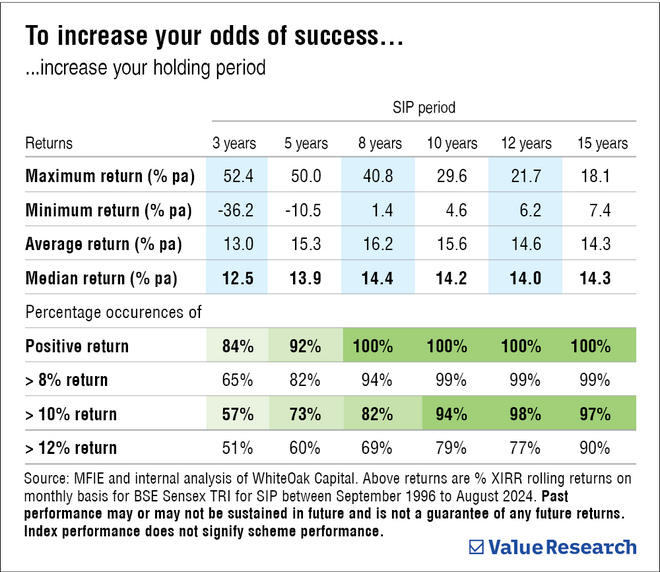
Equities have proved to be a volatile asset class in the past. However, our study reveals that volatility reduces as investors increase their investment horizon (as per data for BSE Sensex TRI).
Moral of the story: The longer the investment horizon, the higher the probability of receiving decent returns!
Which date should you select for a monthly SIP?
Start of the month? End of the month? Middle of the month? Near the last Thursday of the month because of higher volatility due to F&O (futures and options) expiry? Or should you split the SIP amount into multiple-date SIPs?
We tried answering these commonly asked questions using long-period data from BSE Sensex TRI (a widely tracked Indian equity market index). The past 27 years' index data study reveals no meaningful difference between the average return of different dates' 10-year SIPs.
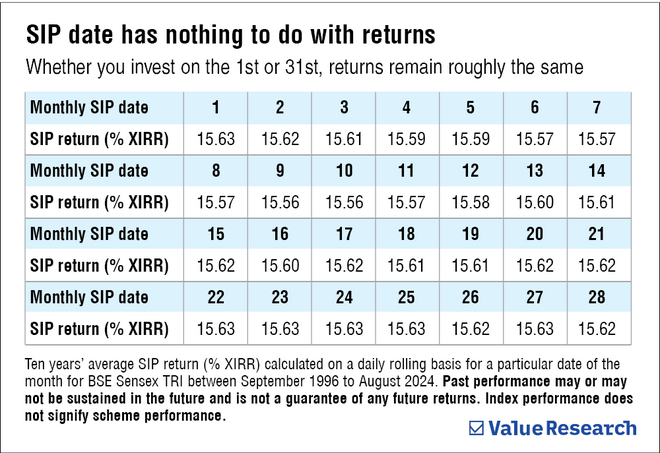
Moral of the story: The best SIP date in our view, is when an investor usually receives money in their bank account (for instance, the day you receive your salary).
Which SIP frequency should you select?
A historical data analysis provided in the table 'All that matters is discipline' suggests that, in the long term, it hardly matters if the investor invests via daily, weekly or monthly SIPs. All three frequencies end up generating somewhat similar returns.
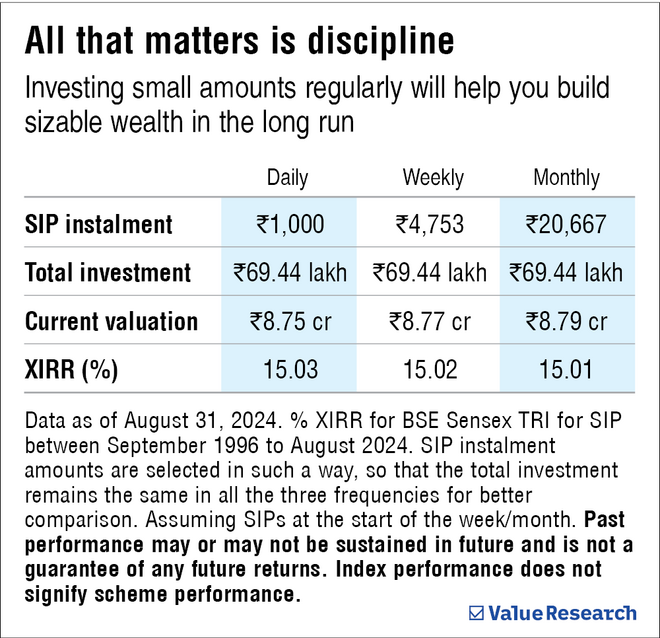
The key takeaway from the analysis is to focus on investing a small amount regularly for the long term.
Moral of the story: Starting investing through SIPs early and running them for the long term is more important than what frequency one selects!
To conclude
A successful SIP is more about 'starting early', maintaining the discipline of 'investing regularly', investing for the 'long term' to achieve our 'financial goals' and less about 'which date', 'which frequency', 'at what stage of the market cycle', etc.
Manuj Jain, a CFA charterholder, is a Director and Co-Head of Product and Strategies at WhiteOak Capital Asset Management Company. He has been with the company for over two years and has over 16 years of experience in asset management. Part of the WhiteOak Capital Group, WhiteOak Capital Asset Management Company is the sponsoring entity of WhiteOak Capital Mutual Fund.
Also read: Which is better, starting SIP at the top or bottom?
Ask Value Research 
 New episodes every Friday









 New Process Alert
 Seems like you've uploaded a wrong QR code. Please upload the QR code downloaded from MF Central platform.


