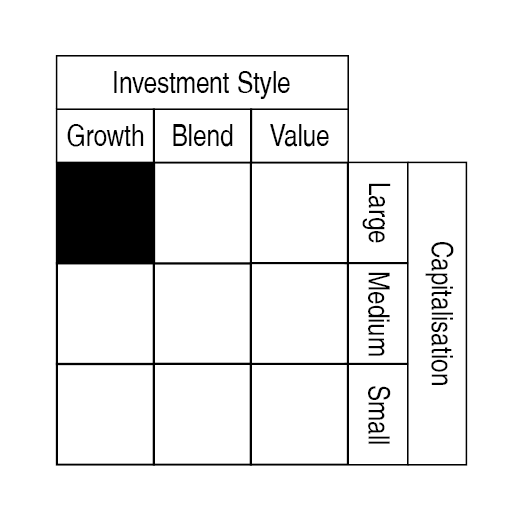
Equity style box for a mutual fund is a broad measure of its portfolio orientation in terms of market capitalisation and its investment style. It is represented as a 3x3 matrix (made up of 9 cells) wherein the columns represent the investment style in terms of valuation, and the rows represent the market capitalisation of the fund’s portfolio.
A higher portfolio market cap represents the dominance of larger and better-established companies. Large-cap stocks are usually more stable than small-cap, which are usually more volatile and less liquid. Market-cap classification is based on SEBI-defined cap ranking methodology. Listed equity stocks are ranked in the descending order of full market capitalisation. The top 100 companies by market capitalisation are classified as large-cap stocks, the next 150 companies (ranked 101 to 250) are classified as mid-cap stocks, and all remaining companies are classified as small-cap stocks. This classification is updated every six months, based on the data as of June and December of each year.
In terms of investment style, a fund may follow growth investing, value investing or a combination of both (which we call blend). Growth stocks typically have above-average price-to-earnings ratio (P/E) and price-to-book value ratios (P/B). In contrast, value stocks have low P/Es and P/Bs.

The matrix is created for mutual funds having equity in their portfolio, i.e., all equity and hybrid funds. Thus, only one of the boxes in the matrix is highlighted, which provides the characteristic investment style and market capitalisation of the fund’s portfolio for a given portfolio disclosure.
Example: Suppose we have an equity mutual fund with the below fund style box. Here, we can identify that the fund follows a ‘Growth’ investment style and has a ‘large-cap’ orientation in terms of market capitalisation.
The methodology for this is quite straightforward. We list all the equity holdings of a mutual fund portfolio, including any underlying mutual fund holdings it may have.
Thereafter, there are two parts to it. We calculate (i) the Portfolio MarketCap and (ii) the Portfolio Valuation Score. Broadly speaking, the MarketCap and Valuation Score (as determined through P/E and P/B) of each of the equity constituent companies is aggregated in proportion to their weightage in the portfolio, to determine the fund’s overall MarketCap and Valuation Score.
The valuation score provides a bird’s eye view of the fund portfolio’s orientation in terms of the risk it carries regarding allocation to the market-cap segment (i.e., Large, Mid or Small) and the style followed by the fund manager (in terms of Growth, Value or Blend).
 New Process Alert
 Seems like you've uploaded a wrong QR code. Please upload the QR code downloaded from MF Central platform.


